Soil testing provides the baseline information needed to make smart fertiliser decisions. However, not all soil tests are created equal. Dawson Agriculture offers three tiers, Standard Soil Test, Zonal Testing and EM Surveying, to match the level of detail growers require[1]. Choosing the right test depends on how uniform your paddocks are and how precisely you want to manage nutrients.
The Standard Soil Test is the entry-level option. It involves taking five cores per paddock, bulking them and conducting a basic nutrient analysis for nitrogen, phosphorus, potassium and sulfur (NPKS)[2]. This test provides a broad snapshot of nutrient status and is suited to small-scale operations or fields with relatively uniform soils. For farmers who need quick guidance on fertiliser decisions without a big investment, the standard test offers valuable insights.
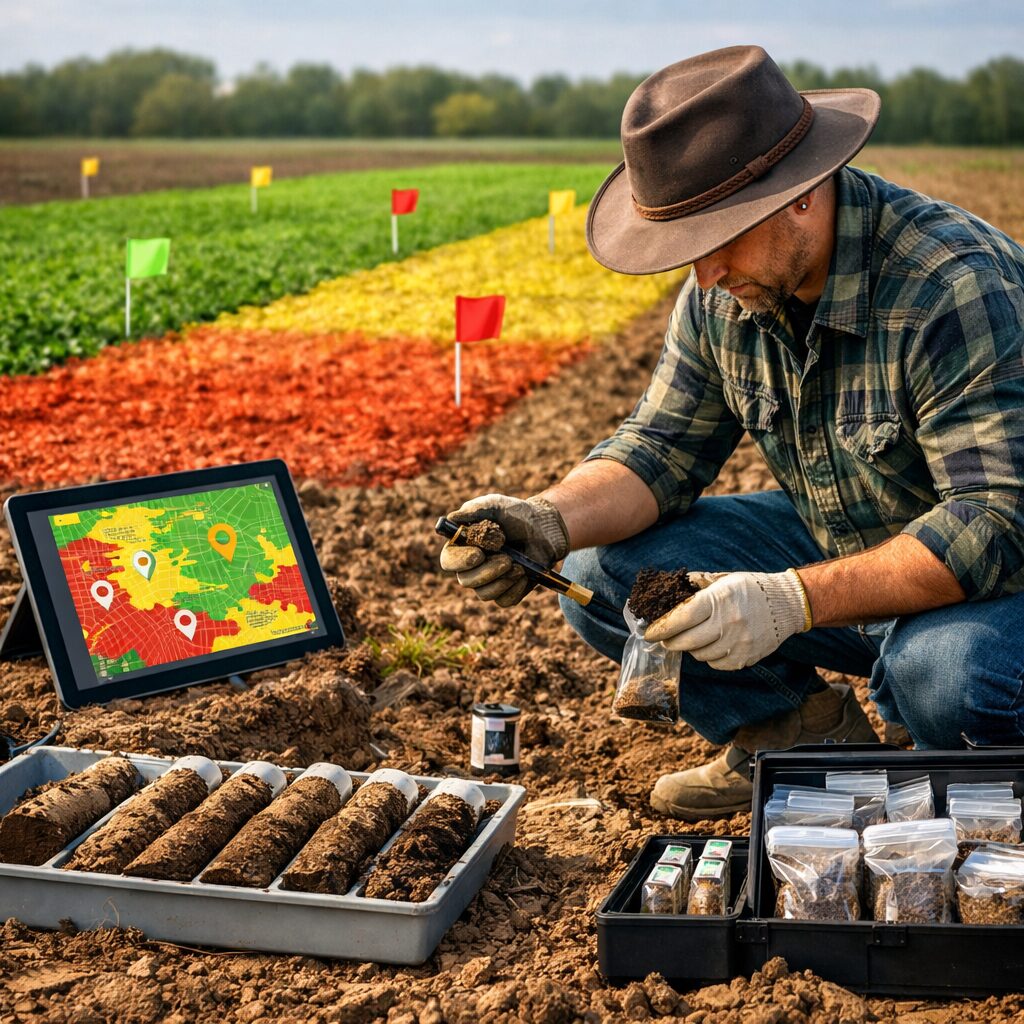
When you’re aware of yield variation across your paddocks, Zonal Testing provides a more tailored approach. Zones are delineated using NDVI imagery or electromagnetic (EM) data, recognising that soil and crop variability can change drastically within a field[3]. Samples are collected separately within each zone, up to four layers per zone, and analysed individually. This allows agronomists to tailor fertiliser rates to specific areas, improving efficiency and avoiding over- or under-application[4]. Zonal testing is ideal for farms seeking to adopt variable-rate fertiliser plans and wanting to make the most of precision technology.
For maximum detail, EM Surveying uses electromagnetic sensors to create soil conductivity maps, which are then used to define zones for sampling. EM surveying produces the most comprehensive nutritional data and is designed for precision-farming clients who utilise variable-rate applications and want to capture multiple layers of information[5]. By pairing EM data with NDVI imagery, farmers can map both soil variability and crop performance, generating highly customised fertiliser prescriptions.
Selecting the right soil test involves weighing cost, field variability and management goals. A standard test may suffice for homogeneous paddocks or initial assessments. Zonal and EM-based tests are better for fields with diverse soils, where precise nutrient management can unlock yield potential and save on fertiliser costs. With input prices high and margins tight, investing in the appropriate level of soil testing ensures that every fertiliser dollar is well-spent.
References
- [1] [2] [3] [4] [5] Top #1 soil testing firm in QLD | Dawson Agriculture https://www.dawsonag.co/soil-testing-queensland/