Verticillium wilt in cotton across Australia costs growers more than they realise, and nowhere more quietly than across the MacIntyre Valley and Darling Downs cotton country. It doesn’t flatten a paddock the way fusarium can, and it doesn’t show up early enough to scare anyone in November. It turns up in January and February, when the canopy is closing and the irrigations are stacking up, and by then your variety choice is locked in for the season. Growers ring us asking what to spray. The honest answer is nothing. There is no in-crop chemistry that will fix verticillium once it’s in the plant. The decisions that matter were made at planting, and most of them were made on soil temperature, variety, and bed preparation, not on a fungicide label.
That’s why our experienced cotton agronomists across QLD and NSW spend so much time on pre-plant variety calls and in-crop monitoring. The job isn’t to spray it out. The job is to make sure the next season’s planting plan reflects what the disease did this season. Below is how we think about it, with current Cotton Seed Distributors guidance threaded through.
Why verticillium is the wilt you can’t spray away
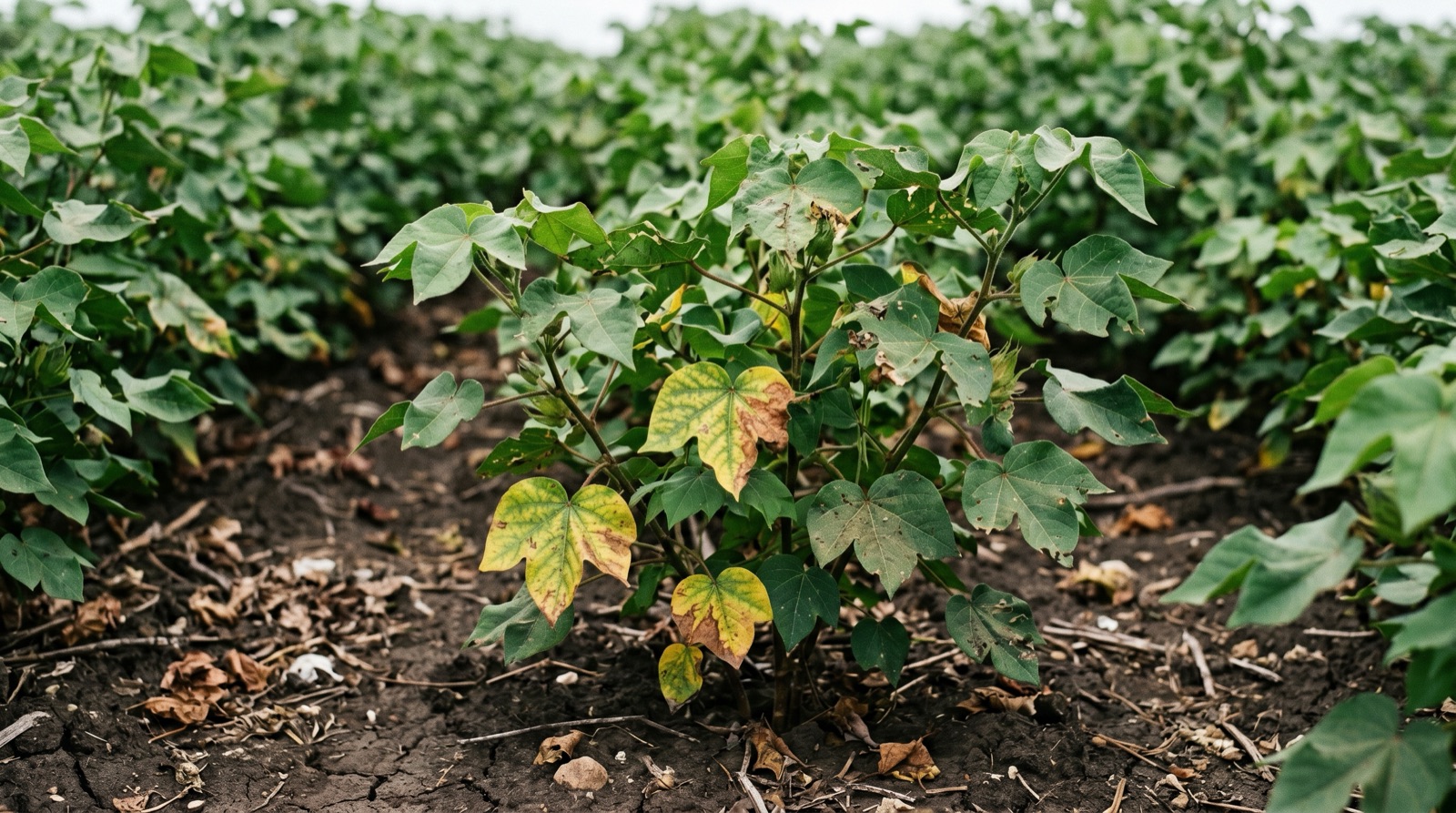
Verticillium wilt is caused by Verticillium dahliae, a soilborne fungus that survives in the soil as microsclerotia for years between cotton crops. It enters the plant through the roots, colonises the vascular system, and restricts water movement up the stem. The classic symptoms are interveinal chlorosis, marginal leaf scorch, premature defoliation, and vascular browning when you split a stem. By the time you see those symptoms, the fungus is already inside the xylem and the season’s yield ceiling has been set.
There is no registered in-crop fungicide that controls verticillium in Australian cotton. Management is entirely about reducing inoculum, choosing tolerant varieties, and not handing the disease the conditions it needs. That last point is where most paddocks come unstuck.
The soil temperature trigger growers underestimate
Verticillium is a cool-soil disease. Cotton Seed Distributors notes that even high-tolerance varieties show little disease incidence at soil temperatures of 25 to 27 degrees Celsius, but become noticeably more susceptible when soil temperatures fall to between 20 and 22 degrees[1]. That’s a narrow window, and it’s the window most growers walk into during the first irrigation if they’re not paying attention.
A 38 degree day in January doesn’t mean your soil is warm. Cold irrigation water, a humid canopy, and lateral or pivot irrigation that wets the surface frequently can drop soil temperature in the root zone for long enough to give the fungus a foothold. CSD specifically warns against frequent lateral or pivot irrigation in disease-prone fields because it creates “cooler wet and humid environments”[1]. If you’ve got verticillium history and you’re running a pivot, the irrigation strategy itself is a disease management decision.
Variety choice and current CSD guidance
Variety is the single biggest lever you have. CSD’s verticillium management page identifies Sicot 606B3F and Sicot 714B3F as showing high tolerance, both rating well on Vrank in the 2022/23 season[1]. That tolerance is real, but it isn’t immunity. Tolerant varieties still lose yield under heavy disease pressure, particularly when soil temperatures fall into that 20 to 22 degree band.
We are totally independent. We don’t sell seed and we don’t get rebated by any seed company. When we sit down with a grower at Goondiwindi or Dalby and look at last season’s results, the variety call is based on the disease history of that paddock, the planting date you can realistically hit, and the irrigation system you’re working with. If you’ve had verticillium pull yield out of a paddock for two seasons running, putting a susceptible variety back in because the fibre premium looked good is a decision the disease will punish.
Check the current season’s Vrank ratings before locking in seed orders. CSD updates them annually and the rankings move as new varieties come through.
Field factors: skip-row, bed height, DNA incidence mapping
Three field-level factors matter, and they’re cheap relative to losing a hectare of yield.
Bed height. CSD recommends high beds because they warm faster than low-formed beds[1]. If you’re hilling up at planting, get the beds up. A few extra centimetres of bed height can be the difference between root-zone soil at 24 degrees and root-zone soil at 21 degrees during a cool snap.
Skip-row. CSD notes that skip-row configurations may reduce disease uptake by allowing more radiation through the canopy and improving temperature in the root zone[1]. It’s not a silver bullet, but on heavily affected paddocks it’s a tool worth considering alongside the yield-per-hectare trade-off.
DNA incidence mapping. Soil DNA testing for verticillium inoculum, available through commercial soil testing services, lets you build incidence maps before you plant[1]. Those maps inform field selection (do you plant cotton there at all this year?), variety choice within a field, and rotation decisions. It’s not a routine test for every grower, but for paddocks with a known history it removes the guesswork from planning.
Planting date windows and verticillium risk
Early planting into warm soil with strong establishment vigour is one of the better non-chemical defences against verticillium. CSD lists early planting for early maturity as a key management point because it gets the root system established and the canopy closed before the back end of the season hands the disease its preferred conditions[1].
That doesn’t mean planting cold. The CSD advice is about hitting the planting window with adequate soil temperature, not chasing the calendar. A planting window in early to mid October on the Downs into 14 degree soil is a worse decision than waiting a fortnight for 18 to 20 degrees, even if the contractor is breathing down your neck. Cold-soil establishment lets verticillium into a stressed seedling and shapes the rest of the season.
Deep root development matters too. CSD specifically calls out the importance of root systems penetrating below 15cm[1]. Compaction layers, planting too shallow, or soil structure that pulls roots sideways instead of down all increase the susceptibility window.
What to monitor through the season
From mid-December onward, every paddock with verticillium history needs fortnightly monitoring, or more frequently around each major irrigation. Things to check on each visit:
- Interveinal chlorosis on lower and mid-canopy leaves, mapped by location within the paddock
- Soil temperature at 10cm depth pre-irrigation and 24 hours post-irrigation
- Vascular browning on suspect plants, split a stem and check
- Pattern of symptoms, is it tracking with low spots, irrigation runs, or earlier-affected zones?
- Defoliation timing and whether premature leaf drop is starting before cut-out
The point of the monitoring isn’t to spray, it’s to build the dataset that drives next year’s variety and rotation calls. Our cotton monitoring service documents disease incidence by paddock through the season so the post-harvest debrief is grounded in observation, not memory.
This is also where Dawson Ag’s independence matters. Jeremy Dawson holds a UNE Certificate in Cotton Production and has 25-plus years across QLD and NSW cotton country. The recommendation a grower gets after a verticillium-affected season isn’t shaped by a seed rebate or a fungicide budget, because there isn’t one. It’s shaped by the paddock data and the rotation options that actually fit the operation.
Variety decisions for 2027 planting based on 2026 results
Post-harvest is when the verticillium decisions actually get made. If the 2026 season showed disease symptoms in a paddock, the 2027 plan needs to address it directly:
- Heavy incidence: rotate to a non-host crop. CSD lists corn and sorghum as suitable rotation options[1]. A two-year break is more useful than a one-year break.
- Moderate incidence: shift to a high-Vrank variety, raise the beds, look at the irrigation strategy. DNA test the worst zones before planting.
- Low incidence with history: stay on a tolerant variety, keep early planting, manage soil temperature aggressively at first irrigation.
Across QLD and NSW, the growers who consistently pull yield out of verticillium-prone country are the ones who treat it as a multi-season problem, not a single-season problem. The “Come Clean, Go Clean” hygiene practice CSD recommends, machinery cleaned between paddocks to avoid moving infested soil, is part of that long view[1]. So is being honest about which paddocks shouldn’t be in cotton at all this year.
Managing verticillium wilt in cotton across Australia: get the plan right early
If you’re planning the 2026/27 cotton crop on country with verticillium history, the variety, planting date, bed height, and irrigation calls all need to land before the planter rolls. We work with growers across the MacIntyre Valley, Darling Downs, and Northern NSW cotton belt as totally independent agronomists, with active participation in GRDC and SPAA research feeding into the advice.
Get a cotton disease check with your in-crop monitoring and we’ll map verticillium risk paddock by paddock as part of the season’s monitoring rounds.
References
- [1] Verticillium Wilt Management, Cotton Seed Distributors Knowledge Library https://csd.net.au/knowledge_library/verticillium-wilt-management/
- [2] Verticillium Wilt, CottonInfo https://www.cottoninfo.com.au/news-and-publications/publications-and-resources/verticillium-wilt