The headline out of the APVMA’s paraquat review is that neither paraquat nor diquat has been banned. That is a good outcome, and it is the part most growers have already heard. The change that matters more for how you actually farm sits underneath it: the maximum rate for conventional boom spraying has been cut to about 1 L/ha of a 250 g/L product. If you run a boom across your fallow, that is a different tool to the one you have relied on. As independent agronomists across the Darling Downs and southern Queensland, our job is to help you work out where paraquat still fits and where it no longer does.
What the new paraquat labels actually change
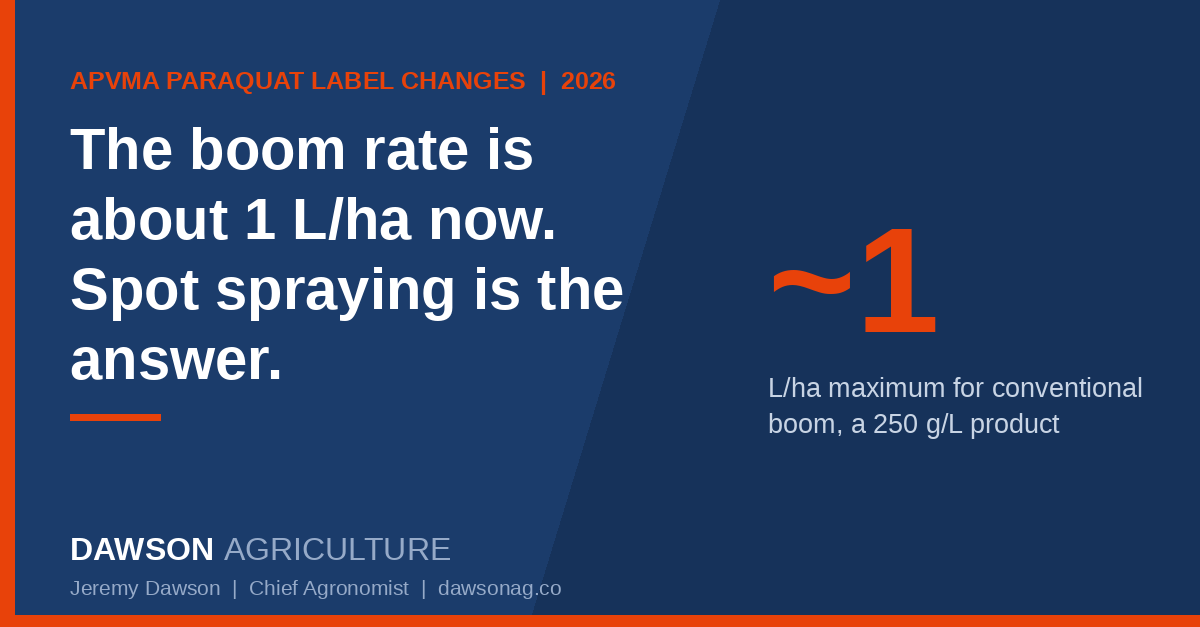
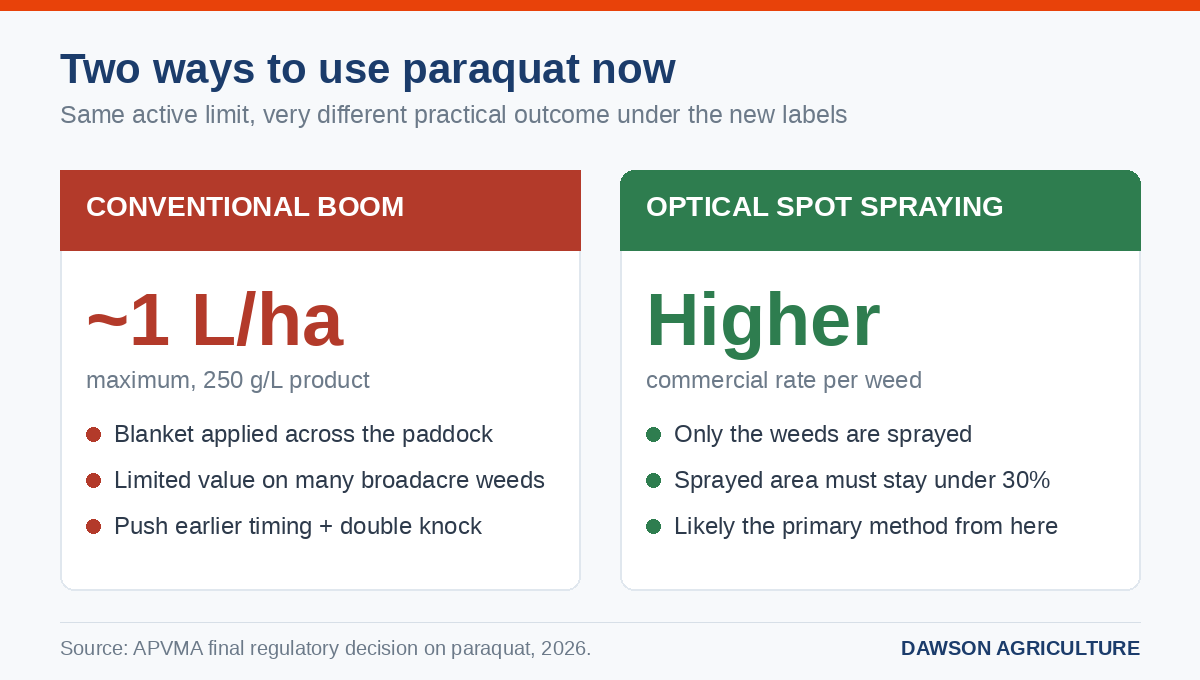
The revised maximum rate for conventional boom spraying is 231 g of active ingredient per hectare. For a 250 g/L paraquat product, that works out to roughly 0.9 to 1.0 L/ha. Two points are worth being precise about, because there has already been some confusion in the paddock.
First, this is a maximum application rate per pass, not a cumulative annual limit. There is nothing in the final decision that caps how much active you can apply across a whole year. It caps what you can put out in a single application. Second, the higher rate for technology-assisted spot spraying is a genuine, separate provision in the decision, not a loophole. More on that below.
Why the boom rate cut matters most
The reduction in the maximum rate for conventional boom spraying is, in our view, the most significant outcome of this review. Historically, Dawson Ag has rarely recommended less than 1.8 L/ha of a 250 g/L paraquat product for reliable control of broadacre fallow weeds. Lower rates can still have a place on very small, actively growing weeds under ideal conditions. But the new maximum of around 1 L/ha will have limited practical value across many broadacre farming systems in southern Queensland and northern New South Wales.
For many growers, this effectively removes paraquat as a practical option for conventional boom spraying where robust, reliable weed control is required. Small, actively growing weeds should still be controllable. Large fleabane, feathertop Rhodes grass, sowthistle, button grass and moisture-stressed weeds are the ones that become much harder to control with paraquat alone once the higher rates are off the table.
Optical spot spraying is where paraquat still pays
The revised labels recognise the value of optical spot spraying technology, and this is the important part of the decision for anyone thinking about where paraquat fits from here. Where optical spot spraying systems are used, higher application rates remain available, because only a small proportion of the paddock is actually treated. That lets you keep applying a commercially effective rate to individual weeds while staying within the revised label requirements. The key condition on the new labels is that the sprayed area must not exceed 30% of the total paddock area.
If you are running WEED-IT, Bilberry, John Deere See & Spray, WeedSeeker or a similar platform, your position is far less affected than a grower relying on blanket boom applications. Rather than applying a marginally effective rate across an entire paddock, optical spot spraying lets you put a commercially effective rate only where the weeds actually are. That is a better outcome agronomically, and it is now the better outcome on the label as well.
What this means for your weed control program
Growers relying on conventional boom spraying will need to place greater emphasis on early weed control, targeting small actively growing weeds; maintaining effective double knock strategies; alternative knockdown herbicides where appropriate; residual herbicides; and integrated weed management to keep herbicide resistance in check. For growers already using optical spot spraying, the impact of the revised labels is expected to be considerably less.
Two practical points before you plan
There is a transition period. New registration conditions apply to products manufactured with the new labels straight away, but existing stock carrying the old label can continue to be used according to that label over a two-year phase-out. What is in your shed now is still usable, so it is worth knowing exactly what you are holding. The revised labels also bring new operator safety requirements, including enclosed mixing and loading systems, the phase-out of backpack sprayers, and enhanced PPE.
Our recommendation
Review your current fallow weed control program before the revised labels become widespread. Optical spot spraying is likely to become the primary application method for paraquat in broadacre farming. It allows commercially effective rates to be applied directly to target weeds while complying with the revised label requirements and reducing overall herbicide use. Beyond that, successful weed control will keep coming back to the same fundamentals: timely applications, targeting small actively growing weeds, and integrating chemical and non-chemical control to manage resistance and protect long-term control.
If you would like to review your fallow weed control program before planting, or work out how these changes affect your farming system, get in touch with Dawson Agriculture.
Source: APVMA final regulatory decision on paraquat, 2026. This article is general information and not a substitute for the registered product label. Maximum rates and conditions vary between products and registered uses, so always confirm against the specific label at the time of use.