Tebuthiuron is one of the main tools for woody regrowth on grazing country. It is also one of the most tightly regulated, and the federal rules changed in December 2025. Get it wrong and it can cost you twice: once in a rate that does not kill what you paid to kill, and again if the job turns out to be a clearing breach. As independent agronomists across southern Queensland and northern NSW, we get asked about both, so here is what to check before you spread.
How tebuthiuron works, and why the rate matters
Tebuthiuron is a residual herbicide applied to the soil, mostly as a pellet. Plants take it up through their roots, not their leaves, so nothing happens until enough rain washes it down into the root zone. It is also slow. Trees can drop their leaves and reshoot more than once before they die, and some species take anywhere from six months to two years. The labels say a single application is normally effective for several years, so give it time before you judge the result or think about a second treatment.
The right rate comes down to your soil and what you are trying to kill. Clay soils hold on to the chemical, so heavier clays need more product than lighter soils, and dense regrowth needs more than light regrowth. For brigalow regrowth, the label rate for a 200 g/kg pellet runs from 7.5 to 15 kilograms of product per hectare (1.5 to 3 kilograms of active ingredient), so the top of the range is double the bottom. Too light and you pay for a partial kill. Too heavy and you have paid for product you did not need, and anything above the label maximum is off-label.
Before you order, check the label on these points:
- False sandalwood. The labels only claim partial control and suppression. Do not expect tebuthiuron to clean it up.
- Wattle and mulga. Native wattles other than brigalow and gidgee, and mulga, are not on the labels. Using it on them is off-label, and we will not recommend it.
- Restraints. Among other things, the labels we have read rule out treating land that will go under field crops within five years, applying within 100 metres of a recognised watercourse, and applying near trees you want to keep or anywhere their roots may reach. They also rule out steep and salt or erosion prone country, and require you to keep a share of the trees for shade and wildlife corridors. Decide before you spread whether that block stays in grass.
In Queensland, poisoning a native tree is clearing
Under the Vegetation Management Act 1999, to clear vegetation includes to poison it. Spreading tebuthiuron under a native tree is regulated the same way as pushing it over.
The Act only covers native plants. Introduced woody weeds such as parkinsonia, prickly acacia, rubber vine and lantana are not “vegetation” under the Act, so killing them is not clearing and needs no approval under that Act. But tebuthiuron does not pick and choose. Native trees whose roots reach the treated area are at risk as well, and killing them counts as clearing wherever they sit in a regulated category.
Which rules apply depends on the vegetation category shown for your property on the regulated vegetation management map. The ones you are most likely to see on grazing country:
- Category X is not regulated under the Act. The label and the federal rules still apply.
- Category B is remnant vegetation.
- Category C is high value regrowth that has not been cleared for at least 15 years.
- Category R is regrowth within 50 metres of a watercourse in the Great Barrier Reef catchments. The Condamine, Border Rivers and Moonie country is outside those catchments, but the Dawson River country further north is inside them.
Category X can also be remapped as Category C when the maps are updated each year, unless it is locked in by a property map of assessable vegetation (PMAV). Check the current map before every job. The vegetation management report for your property is free: go to www.qld.gov.au and search “property report”, or ring 135 VEG (135 834).
The clearing codes name tebuthiuron
Queensland’s accepted development vegetation clearing codes let you do some low-risk clearing in regulated categories without a development approval, as long as you notify the department before you start and follow the code to the letter. Three of them, for managing regulated regrowth, managing weeds and managing encroachment, give tebuthiuron as an example of a “root-absorbed broad spectrum herbicide” and restrict it:
- Managing regrowth density under the regrowth code: root-absorbed herbicides and aerial application are both ruled out, so tebuthiuron cannot be used for that purpose at all.
- Managing weeds: no aerial application, nothing within 100 metres of the defining bank of a wetland, watercourse or drainage feature, and nothing within 30 metres of a mature or habitat tree, or twice its height if that is greater.
- Managing encroachment: this code only covers native woody plants invading the grassland ecosystems listed in it, which is narrower than the way most people use the word. Among other limits: no aerial application, the same 100-metre water buffer, and a 10-metre buffer around mature and habitat trees, or twice their height if that is greater.
The codes measure their 100 metres from the defining bank of a wetland, watercourse or drainage feature, while the label measures from a recognised watercourse. They are not the same line, so work to whichever sits further from the water. There is also no longer a code for thickened vegetation, so thinning it in a regulated category now needs a development approval.
The federal rules changed in December 2025
You may have heard that a federal vegetation management act has overridden Queensland’s. It has not, and no such act exists. The Commonwealth law is the Environment Protection and Biodiversity Conservation Act 1999 (the EPBC Act). It applies alongside the state rules rather than replacing them, so you have to satisfy both.
What did change is the “continuation of use” exemption. Since 1 December 2025 it no longer covers clearing vegetation that has not been cleared in the last 15 years, counted back from the day you do the work. We have not seen a clear ruling on whether an earlier chemical treatment counts as clearing for this test, so do not assume it has reset the clock. This federal test is separate from Queensland’s Category C, which has its own 15-year rule and its own maps. The change also added a 50-metre watercourse rule in the Great Barrier Reef catchments, which do not include the Condamine, Border Rivers or Moonie country.
Losing the exemption is not a ban. It means you need to assess whether the job is likely to have a significant impact on a matter of national environmental significance, such as a listed threatened ecological community or the habitat of a listed species, and refer it if it is. Start with the Protected Matters Search Tool on the DCCEEW website. The listed communities that overlap tebuthiuron country include brigalow, poplar box grassy woodland on alluvial plains, and coolibah and black box woodlands. The department’s own guidance says brigalow regrowth under 15 years old does not need to be referred. Older brigalow regrowth that meets the listing is a different matter, so get advice before you treat it.
A Queensland PMAV gives you no exemption under federal law. Changing land use, such as taking grazing country into cropping, can also take you outside the exemption whatever the age of the regrowth. The rules are still moving, too: new national approval tests and standards start on or before 1 December 2026. If you are unsure, the National EPA offers free pre-referral meetings on 1800 920 528.
New South Wales
Unlike the federal 15-year look-back, NSW works off a fixed date. Under the Local Land Services Act 2013 and its native vegetation code, the line is 1 January 1990: native regrowth that has come up since then can generally be cleared, while older vegetation is regulated. The federal 15-year test still applies, and the NSW Government’s own advice is to check the EPBC Act even if you already have approval under NSW law.
Thinking about a drone?
Drone spreading is being offered around the district, so check what the label allows before you book. None of the registered tebuthiuron labels we have checked mentions drones. Their aerial directions are written for fixed-wing aircraft and helicopters with metering gear, flying at least 20 metres above the target canopy, and the APVMA’s general guidance is that drone application must follow the label’s directions for aerial application. So a drone job has to meet those directions in full. If it cannot, it is off-label.
In Queensland, spreading from a drone is aerial distribution under the chemical distribution law, and it needs licensing even when you are doing it on your own place. The clearing codes we have checked also count a drone as aerial application, which they rule out for tebuthiuron when you are clearing under a code.
Where we can help
We are independent, so our advice is not tied to any product or supplier. Our agronomist Jeremy Dawson can work through the following with you over the phone:
- the label rate for your soil type and the species and density you are targeting
- reading your property report and working out which rules are likely to come into play
- what to check, and who to ask, if the federal test or a listed community might apply
Have your lot on plan handy and a rough description of the country. Call Jeremy on 0484 058 231, or get in touch with Dawson Agriculture.
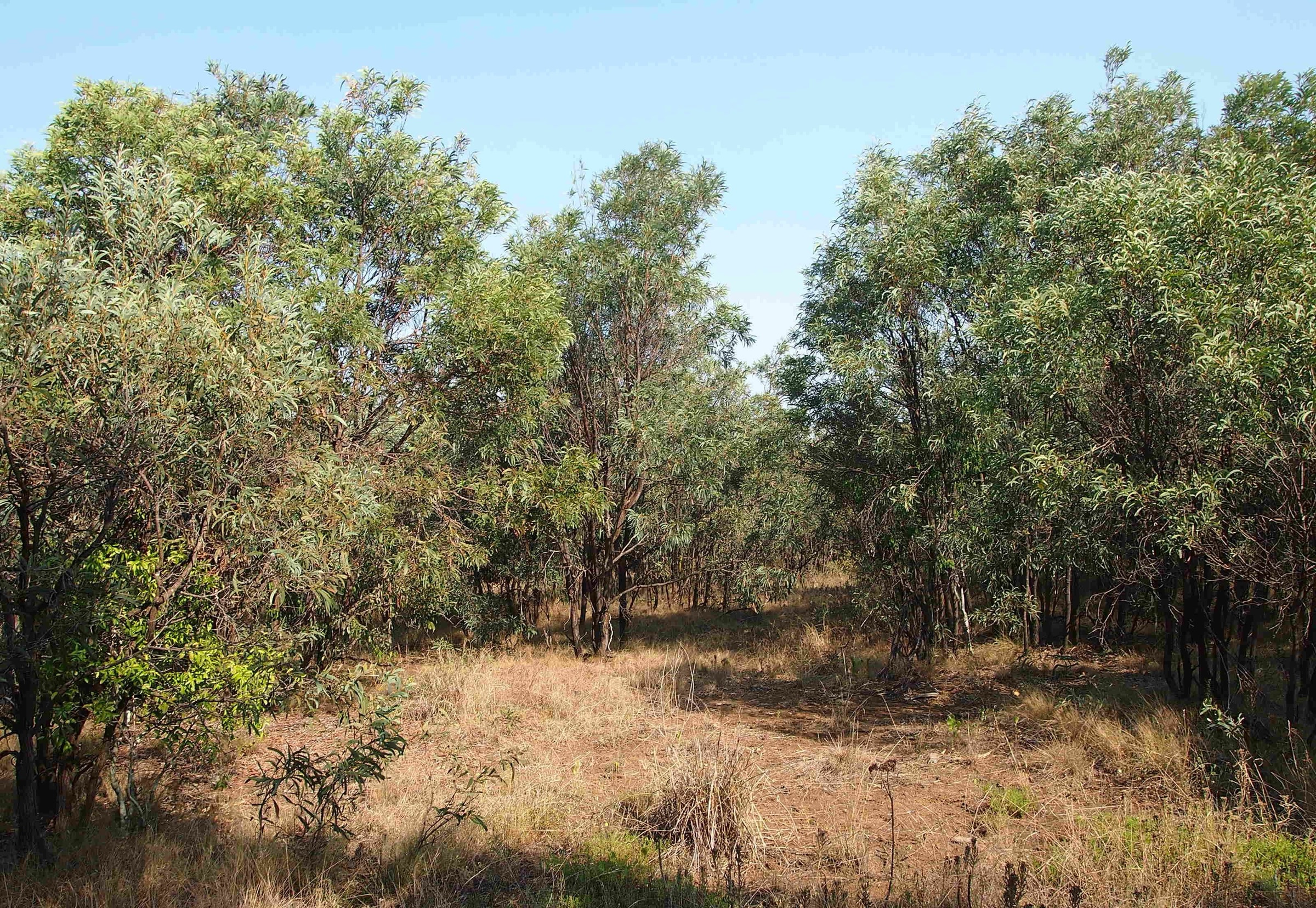
Sources: Vegetation Management Act 1999 (Qld); Queensland accepted development vegetation clearing codes for managing regulated regrowth, weeds and encroachment (effective 22 November 2023); DCCEEW and National EPA guidance on the EPBC Act land clearing reforms; Local Land Services Act 2013 (NSW) and Land Management (Native Vegetation) Code 2018; Agricultural Chemicals Distribution Control Act 1966 (Qld); APVMA guidance on drone application; registered tebuthiuron product labels. This article is general information, not legal advice or a recommendation for any particular property. It reflects Queensland, New South Wales and Commonwealth rules as at September 2026. Always follow the registered label and check your property’s current vegetation map before you treat. Header image: Brigalow regrowth by Mark Marathon, CC BY-SA 3.0.