The cotton planting window MacIntyre Valley growers rely on each spring is narrower than most will admit, and 2026 is shaping up to test it. Every year the same conversation starts around the shed. The planters are greased, the seed is in the shed, the contractor is booked, and the question is how many more mornings to wait. Plant too early into a cold profile and you watch the seedlings sit, the diseases get in front of you, and the stand thins out before it ever closes the rows. Plant too late and you push picking into a wet autumn. As experienced cotton agronomists across QLD and NSW, our job in September and October is to take the guesswork out of that call.
Cotton planting window MacIntyre Valley: the 14°C soil temperature rule
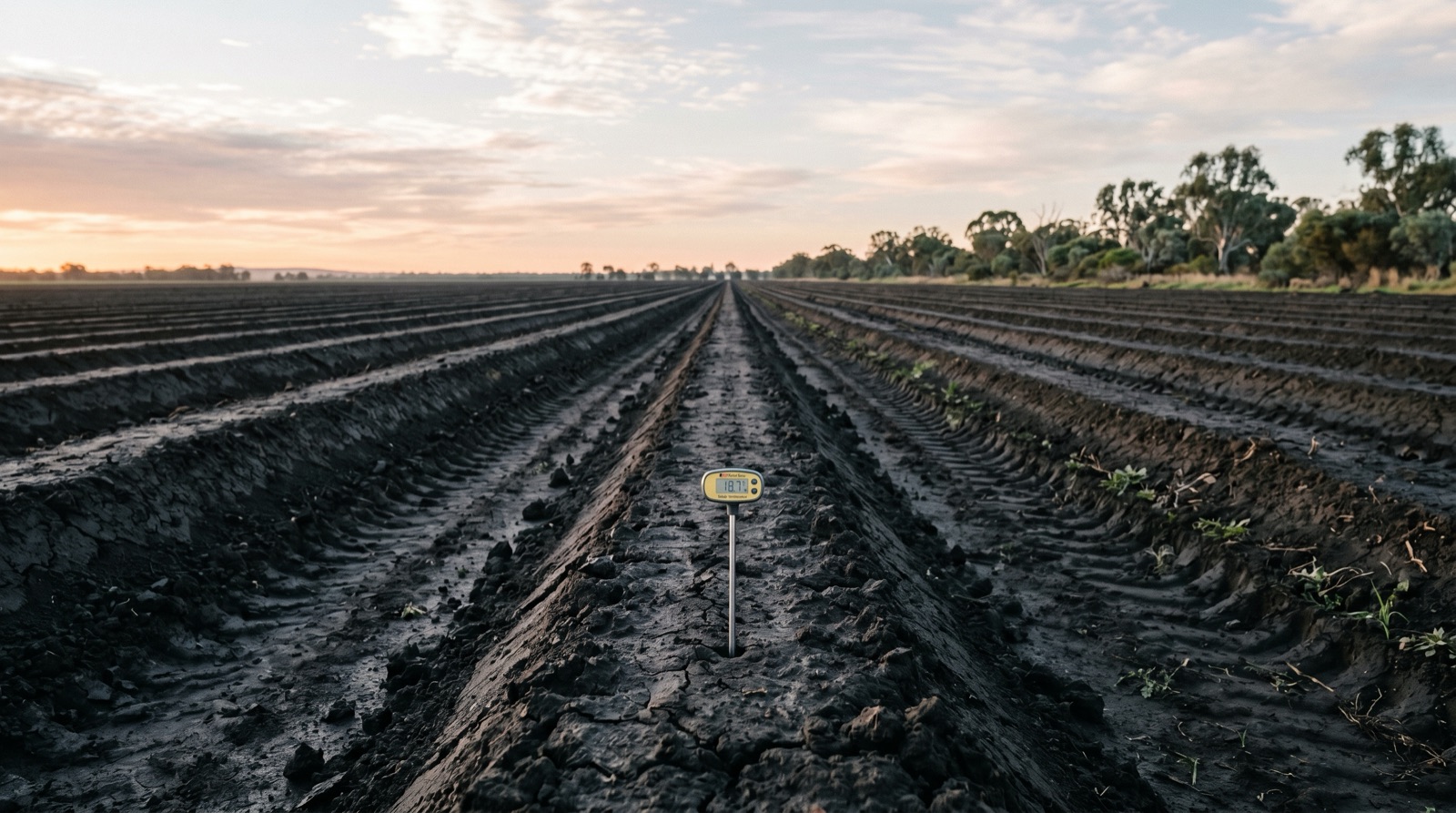
The industry trigger published by Cotton Seed Distributors and CottonInfo is straightforward. Soil temperature at 10cm depth, taken at 8am AEST, needs to be at or above 14°C, and it needs to be tracking up rather than bouncing around[1]. The ideal range for establishment sits between 16 and 28°C[2], so 14°C is a floor, not a target.
The reason it matters is the day-degree maths. Cotton needs heat units to push out of the ground, and CSD’s planting forecast score gives a useful tier. Below 30 day-degrees in the seven days after planting is a do-not-plant call. Below 60 is poor, with slow emergence and uneven stands likely. 61 to 80 is adequate, but expect more than seven days to emerge. Above 81 is good for germination and emergence[1]. We treat the 14°C reading as the gate and the seven-day forecast as the decider.
The trap is reading the temperature off a single morning, especially after a warm afternoon. One 8am number means nothing. Three or four mornings in a row above 14°C with a positive forecast trend is a planting signal.
How the MacIntyre Valley differs from the Darling Downs
The MacIntyre Valley sits roughly 200km south-west of the Darling Downs and a few hundred metres lower in elevation. That changes the planting timing in two ways. First, the valley warms a little earlier in spring than Pittsworth or Oakey. Second, it holds heat through the night more reliably than the eastern Downs because it sits below the range and gets less of the cool air drainage. The practical effect is that growers around Goondiwindi, Moonie, Toobeah and Yelarbon often hit their 14°C trigger one to two weeks earlier than growers up around Brookstead or Cecil Plains.
That doesn’t mean you should plant earlier just because you can. The risk on the MacIntyre is a late frost catching emerging seedlings, particularly on the lighter river country. We’ve seen growers chase a warm September only to watch a 1°C morning in early October cut the crop off at ground level. The valley microclimate can cut both ways.
Reading BoM forecasts for cotton planting decisions
The forecast layer most growers underuse is the BoM seven-day minimum temperature outlook combined with the long-range climate driver summary. We pair three sources before any planting call.
The first is the seven-day point forecast for the nearest BoM station, looking specifically at minimum temperatures and rainfall probability. If the minimums are tracking 8°C or below in the planting week, the day-degree score is going to fall short regardless of what the soil reads at 8am.
The second is the BoM climate outlook for the three months ahead, which gives the probability of above-median or below-median rainfall and temperatures[3]. A wetter, cooler October forecast pushes us towards the back end of the planting window. A hotter, drier outlook pushes us forward.
The third is the ENSO and IOD status. A neutral-to-La Niña pattern with a negative IOD is the classic wet spring setup, which means narrow planting windows between rain events and a higher chance of cold fronts pushing through into October. A positive IOD or El Niño leaning pattern usually gives wider, drier windows but more moisture stress later.
Mid-October versus early-November: pros and cons for 2026
For the MacIntyre, mid-October is the historical sweet spot for irrigated cotton. Soil temperatures are reliably above 16°C, day-degree accumulation is strong, and you give the crop the longest possible run-in to peak flowering before the heat.
Early November plantings sacrifice some of that day-degree advantage but gain insurance. The crop misses the late-season frost risk, you’ve had time to sort water orders and bed prep properly, and you can react to pre-planting rainfall rather than gambling on it.
The 2026 call will hinge on what happens through August and September. If the profile fills with winter rain and soil temperatures track average or warmer, we’ll be planting irrigated country from around 10 to 20 October. If September comes in cool and showery, we’ll hold off until the last week of October at the earliest, and we’ll be running the day-degree forecast every morning.
Irrigated versus dryland: different triggers, same principles
Irrigated cotton runs on the soil temperature and day-degree triggers. You control the moisture, so you can plant the moment the heat unit window opens.
Dryland cotton has a third trigger, and it usually overrides the others. You need a full profile of stored moisture going into planting, ideally 150mm or more of plant available water in the top 120cm. If the temperature window opens but the profile is short, you wait for rain and accept whatever planting date the weather hands you. We’ve planted dryland cotton in the second week of November in years when the moisture finally arrived, and it still produced. Planting dryland into a half-empty profile because the calendar said October is the fastest way to lose money on cotton.
What to plant first, what to plant last
When the window opens, plant your warmest, best-drained country first. Heavy black self-mulching clays on flat ground hold cold longer and drain slower. River loams and lighter beds warm up faster and are forgiving if a cold snap comes through.
Plant your most reliable irrigation paddocks ahead of the marginal ones. Save your refuge crops and any dryland blocks for the back end of the window. If you’re running multiple varieties, get the longer-season options in first and the shorter ones last so they all hit cut-out around the same time.
If you miss the window: what the recovery calls look like
Bollgard 3 has extended the official planting window through to late December[4], but extended doesn’t mean ideal. A late-November or December planting on the MacIntyre means picking pushes into late April or May, which is risky country for wet autumns and frost on the back end.
The recovery decisions we get called in on most often are three. First, whether to push on with cotton or switch the paddock to a summer grain. Second, whether to drop seed rates or change variety to compress the season. Third, whether to commit water to a late crop or save it for the following winter rotation. None of those calls have a textbook answer. They depend on water availability, contracted volumes, machinery scheduling and your appetite for the autumn weather. Because Dawson Ag is totally independent and not tied to any seed company, our recommendation isn’t shaped by what variety we’re contracted to push.
If you’re running cotton on the MacIntyre this season and you want a planting plan that ties soil temperature, BoM data, profile moisture and your specific paddock layout into a single call, that’s exactly what our pre-planting Seasonal Decision Brief is built to do. Jeremy Dawson holds a UNE Cotton Production certificate and 25-plus years of paddock-side experience across the valley and the Border Rivers, and we’ve been agronomists across QLD and NSW long enough to know which calls hold up when the weather doesn’t.
Book a pre-planting cotton consult for 2026
September fills up quickly. If you want a Seasonal Decision Brief in your hands before the planters start moving, book in now. Book a pre-planting cotton consult for 2026.
References
- [1] An Explanation of the Planting Forecast Score – Cotton Seed Distributors https://csd.net.au/knowledge_library/an-explanation-of-the-planting-forecast-score/
- [2] Planting and establishment – CottonInfo https://www.cottoninfo.com.au/planting-and-establishment
- [3] Climate Outlooks – Bureau of Meteorology https://www.bom.gov.au/climate/outlooks/
- [4] Bollgard 3 extended planting window – CottonInfo / Bayer Crop Science https://www.cottoninfo.com.au/seasons/planting